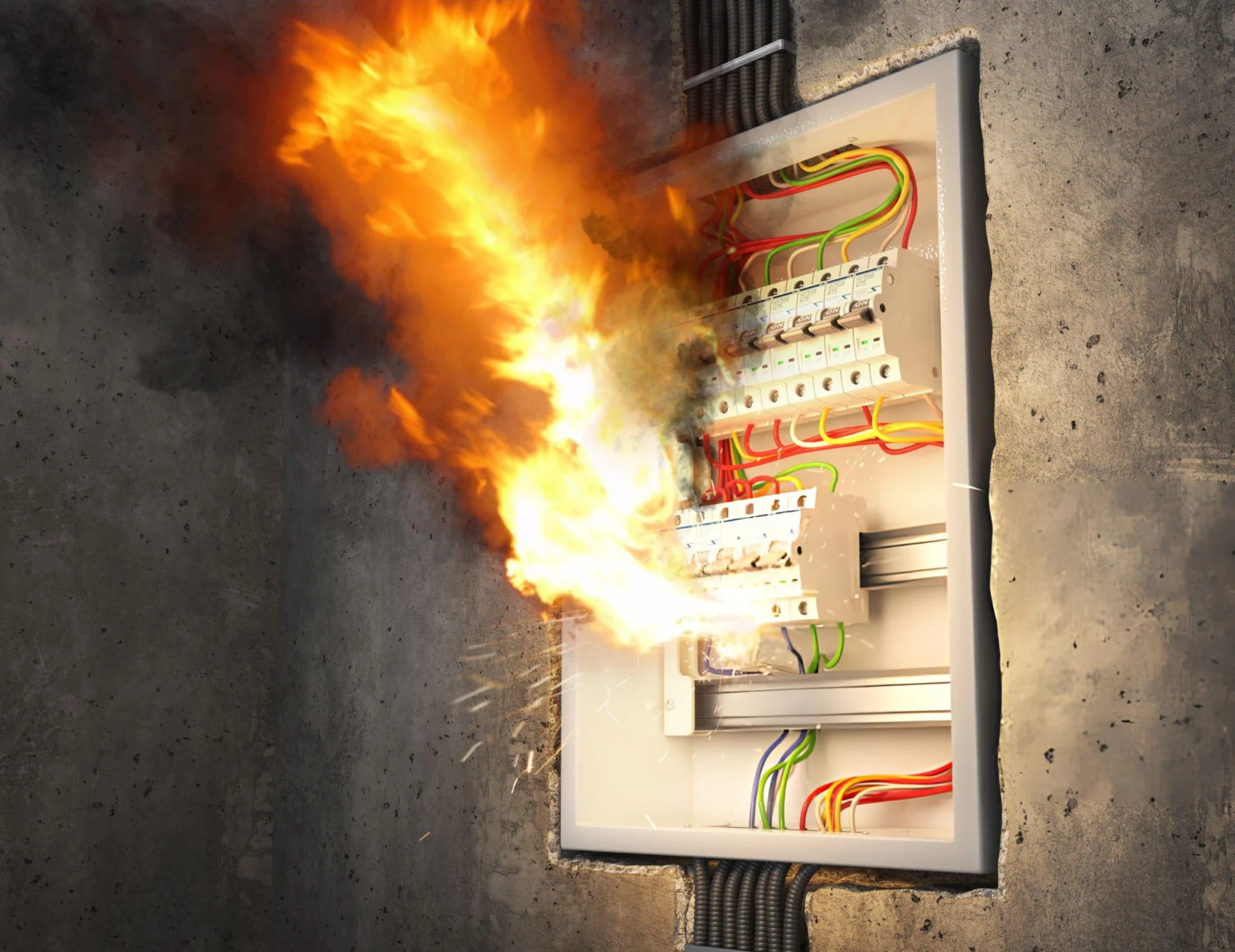
Electricity is an essential convenience, but faulty wiring and overloaded circuits can turn a home or business into a tinderbox. Dublin Fire Brigade’s own statistics show that fire brigades responded to almost 20,000 fires across Ireland in 2024 and that in homes the causes included electrical wiring and equipment alongside cooking and heating. The same data recorded 25 fire‑related deaths in Irish homes in 2024, with most victims aged over 55. These figures highlight that fires remain a serious risk and that electrical systems are a notable contributor.
Electrical faults are a real cause of house fires
Fire‑brigade reports and news stories show that electrical faults can spark devastating fires even in ordinary homes:
- Overheating chargers – A house in Castleknock, west Dublin, was “extensively damaged” when a phone charger left on a bed overheated and caught fire. Dublin Fire Brigade officers warned that such incidents are becoming more common and advised people not to leave chargers plugged in once devices are fully charged, especially where they touch fabrics.
- Ageing wiring and overloaded sockets – The National Directorate for Fire and Emergency Management notes that electrical wiring and electrical equipment are among the causes of fires attended by Irish fire brigades. Their “Common causes of house fires” report describes how faulty wiring, overloaded sockets and failing appliances are frequent sources of accidental fires, particularly in older homes whose systems were never designed for modern power demands. These examples show that electrical fires do not only happen in industrial settings. Ordinary households and businesses are at risk when wiring is neglected or when multiple appliances are plugged into the same socket. Yet the financial consequences of such incidents are often underestimated.
A PIR is more than a box‑ticking exercise. It provides a written record of the condition of your system, the tests performed and any remedial work needed. Insurers, mortgage lenders and regulators often insist on a current PIR before they will offer cover or sign off on a project. For landlords, providing safe electrics is both a legal obligation and an important duty of care to tenants.
Why insurers demand electrical inspections
Insurance companies base cover on the assumption that policyholders take reasonable steps to prevent fires. Insurers therefore scrutinise electrical maintenance history when a fire claim is made. The fire‑damage guide warns that recent electrical inspections support your claim, while outdated inspection certificates suggest negligence; missing documentation raises questions about coverage. Homeowners are advised to have their electrical systems inspected every five years and to keep all certificates.
Some policies go further. The “Property Owners Select” insurance policy wording states that for any fire or explosion claim to be valid, the property’s electrical installation must have a valid inspection certificate. The policy requires:
- Inspection and testing within 60 days of adding the electrical inspection clause, carried out by a member of the Register of Electrical Contractors of Ireland or another qualified person.
- Defects remedied within 60 days of inspection, and copies of completion and inspection certificates kept for the insurer.
- Re‑inspection every five years or immediately after refurbishment or water damage.
- The clause warns that breach of these terms can give the insurer “no liability” for fire damage unless the non‑compliance did not increase the risk.
In short, your insurance can be voided if you cannot prove that the electrical installation has been inspected and any defects fixed. Insurers require this because poor wiring and overloaded circuits directly increase the risk of fire, and because documented maintenance demonstrates responsible ownership. In practice, this means that before issuing a policy or renewing it, insurers may ask for a Periodic Inspection Report (PIR) or Electrical Installation Condition Report (EICR) and will use it as evidence during claim investigations.
Number of circuits How PIR/EICR reports help prevent electrical fires and protect your claimand fuse boards
A Periodic Inspection Report (also called an Electrical Installation Condition Report) is a thorough examination of a property’s wiring by a qualified electrician. While our previous blog explained what a PIR involves, it’s worth emphasising why it matters in the context of insurance and property damage:
- Identify hidden faults – The Common Causes of House Fires report notes that faulty wiring, overloaded sockets and failing appliances are frequent sources of accidental fires. A PIR tests circuits under load, checks protective devices and spots deterioration that would never be visible during a casual inspection.
- Schedule timely repairs – Inspections typically recommend remedial work, from replacing frayed cords to rewiring old circuits. Most insurance policies give property owners 60 days to remedy defects. Acting quickly not only reduces fire risk but also ensures your insurance remains valid.
- Demonstrate responsible ownership – Keeping copies of inspection certificates proves to insurers that you took reasonable steps to maintain your property. Loss assessors note that recent inspection records strengthen your position and outdated or missing certificates raise negligence concerns.
- Avoid claim denials – As shown in most of the insurance policies, failure to have a valid electrical inspection can allow insurers to refuse liability for fire damage. Having an up‑to‑date PIR/EICR removes this obstacle and ensures your policy responds fully.
Why it matters for businesses and landlords
The requirements above apply to both domestic and commercial properties. In addition to protecting families, employers have statutory duties under the Safety, Health and Welfare at Work Regulations to maintain electrical systems. Landlords must also comply with Standards for Rented Houses, which include regular inspections and certification of electrical installations. Insurers may therefore require proof of compliance before offering cover or settling a claim.
Takeaway: Invest in inspections to save lives and money
Electrical fires in Dublin and across Ireland are not rare. They can start with something as innocuous as an overheated charger and quickly spread through a house. Fire brigades attended nearly 20,000 fires in 2024, and electrical wiring and equipment were among the causes. Property damage settlements frequently exceed tens or even hundreds of thousands of euros, as shown by the recent cases where a kitchen fire caused by an electrical fault ultimately cost around €85,000.
Insurance companies are not being pedantic when they ask for electrical inspection reports. Policies like the Property Owners Select explicitly state that claims for fire or explosion may be refused if a valid inspection certificate is not in place. Recent inspections strengthen the claim, whereas missing or outdated certificates signal negligence and can reduce or void payouts.
Periodic Inspection Reports (PIR/EICRs) are therefore both a safety tool and a financial safeguard. By scheduling inspections every five years (or sooner for older installations) and keeping records of all remedial work, homeowners and businesses can reduce the likelihood of electrical fires, protect lives, and ensure that if the worst does happen, their insurance will respond as expected.